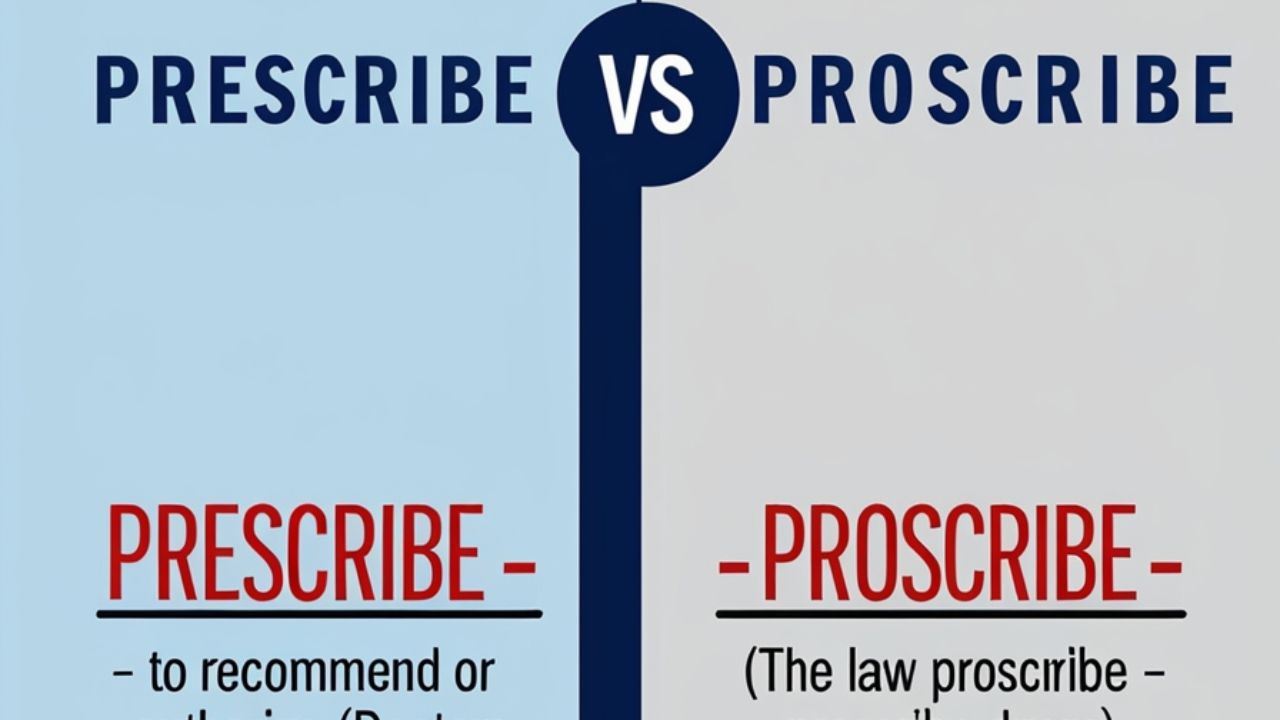
Prescribe vs Proscribe shows how two similar words can mean very different things. Prescribe means to tell someone what they should do or follow, like a doctor giving medicine. It guides people toward the right action with clear and helpful advice.
Proscribe means to stop or forbid something. When a rule or law proscribes an act, it says that people must not do it. This word often appears in serious situations where safety or respect is important in daily life.
Learning the meaning of Prescribe vs Proscribe helps children understand how language shapes behavior. Using the right word keeps communication strong, kind, and correct. It builds confidence and teaches respect for proper word use in every sentence.
Clear Definitions: Prescribe vs. Proscribe
Prescribe means to tell or advise someone to do something good or helpful. A doctor may use it when giving medicine, or a teacher may use it when giving study rules. It guides people toward safe, right, and healthy actions.
Proscribe means to stop or ban something that is not allowed. It helps people stay safe by keeping bad habits or wrong acts away. This word shows control, care, and discipline in rules that protect everyone in a fair way.
| Word | Definition | Tone | Part of Speech |
| Prescribe | To recommend, assign, or authorize (especially in medicine or regulation) | Neutral to positive | Verb |
| Proscribe | To forbid, ban, or condemn | Negative | Verb |
Etymological Origins: Latin Roots Revealed
The word Prescribe comes from old Latin roots. It joins prae, meaning “before,” and scribere, meaning “to write.” Long ago, it meant writing instructions in advance. Today, it still means giving advice or directions that help people act wisely.
The word Proscribe also began in Latin. It joins pro, meaning “forward” or “publicly,” and scribere, meaning “to write.” Long ago, it meant posting a warning or ban. Now it means stopping actions that are not allowed or safe.
- Prescribe comes from the Latin words prae meaning “before” and scribere meaning “to write,” showing the idea of giving directions or advice ahead of time.
- Proscribe comes from the Latin words pro meaning “forward” or “publicly” and scribere meaning “to write,” once used for public bans or warnings.
- Both words share scribere, meaning “to write,” but their prefixes give them opposite meanings — one guides and the other forbids.
How to Use “Prescribe” Correctly
Common Cases for “Prescribe”
- Doctors prescribe medicine to help patients recover from illness or pain.
- Teachers prescribe study plans or reading lists to guide students in learning better.
- Rules or laws prescribe actions people must follow to keep order and safety in daily life.
Tips for Formal Writing
- Use Prescribe properly in reports or essays. It shows direction or advice from a rule, teacher, or guide. This keeps your writing clear, formal, and meaningful.
- Always explain your point with calm and polite words. Avoid slang, short forms, or playful tone in formal pieces. Keep every line neat and respectful.
- Check spelling and sentence order before finishing your work. Well-organized writing helps readers understand ideas easily and shows your care for correct expression.
Quick Fact
- In legal writing, Prescribe often means to officially set a rule or requirement in a law or policy.
- The word Proscribe is used when a law or rule bans or forbids an action completely.
- Both words share Latin roots but give opposite meanings — one advises, the other restricts.
When “Proscribe” Is the Right Word

Typical “Proscribe” Uses
- Governments proscribe acts that break the law, such as stealing or harming others. It helps keep peace and order in society.
- Schools proscribe cheating, bullying, and other bad behaviors to protect students and build respect.
- Religions proscribe actions that go against moral or spiritual values, teaching followers to live kindly and honestly.
See also Appreciative of or For: The Right Preposition Explained
Modern Connotation
- In modern use, Prescribe suggests guidance or approval, often linked to helpful advice, health care, or proper behavior.
- Proscribe now carries a strong tone of restriction, mainly used for laws, policies, or moral rules that forbid harmful actions.
- Both words reflect authority — one gives direction for good practice, while the other sets clear limits to prevent wrongdoing.
Real-World Example
- The doctor prescribes medicine for a sick child to help them recover faster and stay healthy.
- The government proscribes unsafe factories to protect workers from harm and danger.
- The school proscribes rude language on campus so that everyone speaks kindly and respects others.
Side‑by‑Side Contextual Examples
| Sentence Example | Correct Word | Why It Works |
| “The physician ___ a resting period for nine days.” | prescribed | The doctor gives a recommendation; it aligns with its meaning |
| “The city ordinance ___ smoking inside public buildings.” | proscribes | The law formally bans smoking; using proscribe makes sense |
| “The editor ___ a format for all image captions in this journal.” | prescribed | Assigns a format – fits recommendation usage |
| “That rule ___ any discussion of confidential topics.” | proscribes | Forbids discussion; prohibition is implied |
Mini Quiz
- The teacher ___ reading one storybook each week to build good habits.
(Answer: Prescribes) - The city law ___ throwing garbage in open parks or streets.
(Answer: Proscribes) - The doctor ___ a rest period for two days after the check-up.
(Answer: Prescribes)
Pronunciation: The Phonetics That Fool Us
- Prescribe sounds like pri-skraib, with a short “pri” at the start, while Proscribe sounds like pro-skraib, beginning with a longer “pro.”
- The change between “pri” and “pro” is small but important. Listening closely helps catch the vowel difference.
- Saying both words slowly and clearly builds strong pronunciation skills and prevents confusion in speech or reading.
Pronunciation Tips
- Say Prescribe as pri-skraib, starting with a short “pri” sound like in “print.” It sounds light and quick at the beginning.
- Say Proscribe as pro-skraib, beginning with a long “pro” sound like in “program.” It sounds fuller and stronger.
- Practice both words slowly and clearly. Listening to online audio helps you hear the small vowel change between “pri” and “pro.”
Memory Hacks: Mnemonics That Stick
- Prescribe starts with pre, which means “before.” Think of giving advice or medicine before something happens — like a doctor helping early.
- Proscribe sounds like prohibit. Both words mean to stop or forbid actions that aren’t allowed.
- Picture it: a doctor writing a note means prescribe, while a red “X” sign on a rule board means proscribe.
Common Pitfalls & Misuses in Real Writing
Real-World Misuse
- A news article once said a school prescribes cheating, but it meant to say proscribes. The wrong word made it sound like the school allowed cheating.
- A company notice wrote it prescribes misuse of funds, confusing workers who thought bad spending was approved.
- A health post said doctors proscribe exercise for patients, which wrongly suggested banning workouts instead of recommending them.
See also Run Like the Wind: Meaning, Origin & Everyday Uses
Why Mistakes Matter
- Using Prescribe and Proscribe incorrectly can change the whole meaning of a sentence and confuse readers or listeners.
- Such mistakes can cause problems in rules, health advice, or school work because people may follow the wrong message.
- Choosing the right word builds trust, shows care for clear communication, and keeps writing accurate and professional.
SEO & Clarity Impact
- Correct use of Prescribe and Proscribe improves search results because clear language helps search engines understand your topic.
- When words are used wrongly, readers lose trust, and your content may rank lower online.
- Writing with accuracy and clarity keeps your article readable, professional, and easy for both people and Google to follow.
Case Studies: Flipped Meanings Lead to Chaos
Case Study 1: Corporate Policy Notice
- A company policy once said it prescribes misuse of office funds. The team got confused and thought bad spending was allowed.
- The correct word should have been proscribes, meaning the policy forbids misuse or dishonesty.
- This small word mistake caused serious misunderstanding until the company sent another clear notice explaining the real rule.
Case Study 2: Health Authority Announcement
- A health department notice once said doctors proscribe regular check-ups, which made people think visits were not allowed.
- The real meaning should have been prescribe, showing that doctors recommend health check-ups for safety.
- This small mistake led to confusion until the corrected message reminded everyone to keep their routine medical visits.
Case Study 3: Social Media Headline
- A school post online said it proscribes homework during holidays, and many parents thought homework was banned.
- The message was meant to say prescribes, showing teachers wanted students to complete light study tasks.
- The mix-up caused debate until the school clarified that study practice was encouraged, not forbidden.
Pronunciation Practice: Tools & Tips

- Listen to dictionary audio to hear the difference between Prescribe (pri-skraib) and Proscribe (pro-skraib). Repeat each word slowly to train your ears.
- Practice saying both aloud in short sentences daily, like “Doctors prescribe medicine” or “Rules proscribe cheating.”
- Use language apps or pronunciation videos to compare sounds. Focus on the first syllable — “pri” for advice, “pro” for a ban.
Summary Table
| Feature | Prescribe | Proscribe |
| Meaning | Recommend, authorize, assign | Forbid, ban, condemn |
| Tone | Neutral or positive | Formal, negative, emphatic |
| Usage | Medicine, rules, advice | Laws, regulations, history |
| Pronunciation | /prɪˈskraɪb/ | /proʊˈskraɪb/ |
| Common Mnemonic | Pre = before, set forward | Prohibit, pro = ban |
How to Never Mix Them Up Again
- Remember that Prescribe begins with pre, meaning “before,” which links to giving advice or directions ahead of time.
- Think of Proscribe like prohibit — both mean to stop or forbid something completely.
- Say them slowly: “pri-skraib” for guidance and “pro-skraib” for banning. Listening carefully helps your brain remember the difference easily.
Mini Quiz Answers
- Our handbook prescribes detailed steps for reporting problems at work. This shows direction and guidance.
- State law proscribes gambling in public places to maintain peace and fairness.
- Work ethic coaches prescribe daily goal-setting to help people stay focused, positive, and productive.
Conclusion:
Understanding Prescribe vs Proscribe helps everyone use words correctly. One shows guidance, and the other shows a rule to stop something. Knowing their meanings builds strong language skills and keeps spoken or written messages clear and easy to follow.
Right word choice improves learning and confidence. It also helps in school, work, and daily talk. When children understand word meanings early, they grow into careful speakers and writers who express ideas with truth, care, and respect.
Bonus: Related Word Pairs for the Curious
- Affect vs. Effect – Affect means to influence, while Effect means the result of that influence. Example: The weather can affect mood, and its effect may last all day.
- Imply vs. Infer – Imply means to suggest something, and Infer means to understand it from clues. Example: A teacher may imply a rule, and students infer its meaning.
- Compliment vs. Complement – Compliment means to praise, while Complement means to complete or go well with something. Example: The red scarf compliments her dress and perfectly complements her style.
FAQs
What’s the difference between prescribe and proscribe?
“Prescribe” means to recommend or authorize; “proscribe” means to forbid or ban something officially.
Do doctors prescribe or proscribe?
Doctors prescribe medicines or treatments; they don’t proscribe, which means to prohibit.
What is the difference between proscription and prescription?
“Prescription” is a written medical recommendation; “proscription” means official banning or condemnation.
Is perscribe a word?
No, “perscribe” is incorrect. The correct spelling is prescribe.

Join Bibcia on a journey to master English grammar. Discover easy lessons, writing tips, and practical examples designed to make learning grammar simple and effective.