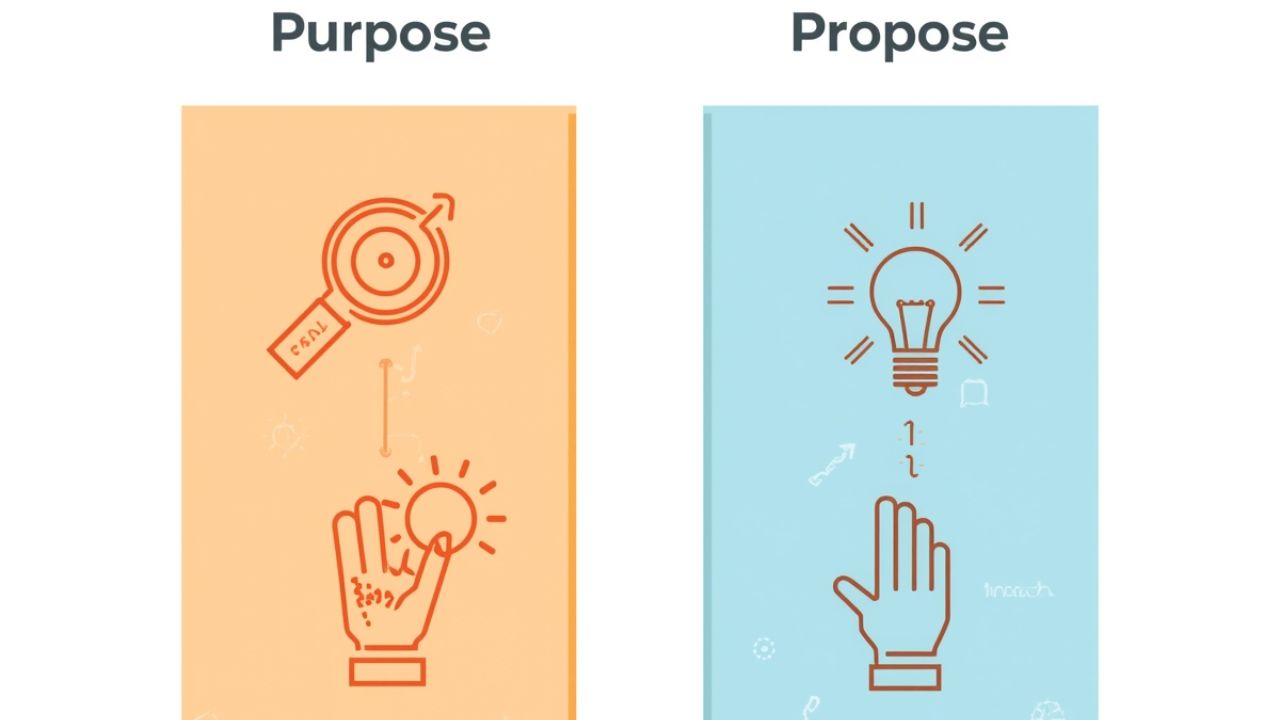
Propose means to suggest or offer an idea. People often propose plans, solutions, or projects to others. It shows an action or a suggestion. Using this word clearly explains what someone wants to do or recommend in a situation.
Purpose is about the reason or goal behind something. Every action or plan has a purpose. It tells why something is done and what result is expected. Understanding this word helps make actions meaningful and focused.
Knowing the difference between these words helps in writing and speaking. Propose is an action, while purpose is the reason. Using them correctly makes communication clear, professional, and easy for everyone to understand.
Understanding “Propose” and “Purpose” – What Do They Really Mean?
| Word | Part of Speech | Definition | Examples |
| Propose | Verb | To offer or suggest an idea, plan, or action for consideration | “I propose we meet next week.” |
| Purpose | Noun | The reason for which something is done or exists | “Her purpose in life is to teach.” |
Where Do They Come From? (Etymology Quick Guide)
- The word propose comes from Latin roots that mean “to put forward.” It was used to show an idea being offered to someone.
- The word purpose comes from an old French term meaning “an aim or reason.” It was used to show the goal behind an action.
- Both words changed slowly over many years, but they still keep their basic meanings. One shows an idea, and the other shows the reason for doing something.
Exploring “Propose”: More Than Marriage
Propose means to suggest an idea or plan to someone. People can propose projects, solutions, or activities in school, work, or daily life. It shows action and helps others understand your thoughts clearly.
The word is not only about marriage. Propose is used in many situations where someone shares an idea. It helps make plans organized, communicates intentions clearly, and shows initiative in any activity or project.
Common Contexts Where “Propose” is Used:
- People propose ideas during school projects to share helpful thoughts.
- Teams propose plans at work to explain how to finish tasks.
- Leaders propose changes to improve rules or systems.
- Students propose topics when choosing subjects for assignments.
- Friends propose activities when planning events or outings.
- Companies propose solutions to fix problems for customers.
Sentence Patterns:
- Use “propose + noun” to show an idea, such as “They propose a plan.”
- Use “propose + action” to show what someone wants to do, like “I propose we start early.”
- Use “propose + change” to explain improvements, such as “Teachers propose new rules.”
- Use “propose + solution” to fix problems, like “The team propose a safer method.”
Did You Know?
In legal documents and formal writing, “hereby propose” is a commonly used phrase to formally suggest a motion or action.
What Is a Purpose? The Heart Behind the Action

The information I have already given above. dont same as copy write in your wording. Write 3 paragraphs of 35 To 45 words about “What Is a Purpose? The Heart Behind the Action” Please use very easy sentences for a prep class boy. Avoid questioning, avoid passive voice. The tone of the article is informative, supportive, and formal. and bold the LIS keywords I mean the main keywords Do not repeat the main keyword again and again. Don’t use the keyword again and again. And Dont keyword Stuffing
Real-Life Uses of “Purpose”:
- Students find the purpose of a lesson to understand what they must learn.
- Workers follow the purpose of a task to complete it correctly.
- A story has a purpose that shows the message or meaning.
- Every rule has a purpose that guides safe and fair behavior.
- A project starts with a purpose to explain its main goal.
- People set a purpose in life to stay focused and motivated.
Purpose Isn’t Just a Word – It’s a Driver
Purpose shows the reason behind actions. Every plan, project, or task has a purpose. Knowing it helps people stay focused, work better, and achieve their goals with clear direction in school, work, or daily activities.
Understanding purpose makes actions meaningful. It guides decisions and motivates effort. When people recognize the reason behind what they do, they can act with confidence, complete tasks effectively, and contribute positively to any project or goal.
Purpose vs. Propose – Key Differences at a Glance
| Aspect | Propose | Purpose |
| Part of Speech | Verb | Noun |
| Function | Suggests or recommends an idea | Gives reason, intention, or motivation |
| Tone | Action-based | Reflective, motivational |
| Example | “She proposed a new method.” | “Her purpose was clear.” |
| Typical Use | Meetings, planning, debates | Life goals, branding, writing objectives |
Common Errors to Avoid
It’s easy to misuse these two words – especially when writing in formal or academic contexts.
Mistake #1: Mixing up parts of speech
“I purpose that we leave early.”
“I propose that we leave early.”
Mistake #2: Using “purpose” as a verb in casual settings

People sometimes use purpose as a verb, but it is incorrect in casual language. The word shows the reason behind something, not an action. Using it properly makes writing and speaking clear and professional.
Always remember that purpose explains why something happens. Saying it as a verb can confuse listeners or readers. Using the word correctly keeps sentences simple, precise, and easy for everyone to understand in school, work, or daily conversations.
Mistake #3: Using “propose” where “intent” is meant
“The propose of the project is unclear.” “The purpose of the project is unclear.”
Real-World Examples: How We Use Propose and Purpose
| Scenario | Propose Example | Purpose Example |
| Meeting | “I propose a weekly report for better tracking.” | “The purpose of this report is transparency.” |
| Essay | “This study proposes a new approach.” | “Its purpose is to fill a gap in research.” |
| Life Planning | “He proposed they move to a quieter town.” | “His purpose was to live a simpler life.” |
| Debate | “She proposed lowering tuition.” | “Her purpose was to improve access.” |
How to Remember the Difference – Quick Tips
- Propose means you share an idea.
- Purpose means the reason behind an action.
- Think: propose = offer.
- Think: purpose = why.
- Use propose when suggesting something.
- Use purpose when explaining a goal.
- Check the sentence: action uses propose, reason uses purpose.
Case Study: Business vs. Branding Language
Company A: Using “Propose”
The team uses propose to share new ideas during meetings. It helps everyone understand fresh plans for projects and daily tasks. This clear communication supports teamwork and keeps the company organized as members offer suggestions to improve work and reach goals smoothly.
Company A uses propose to guide important decisions. Managers listen to suggestions and choose the best options for progress. This approach builds trust, supports creativity, and helps the company grow with steady planning. It also keeps every project focused and easy to follow.
Company B: Using “Purpose”
- The company shares a clear purpose to guide its work and decisions.
- The team follows this purpose to stay focused on long-term goals.
- The brand message uses purpose to build trust with customers.
- Every project starts with a purpose to keep actions meaningful and organized.
Why Getting This Right Matters (SEO + Credibility)
Using correct words builds strong SEO because search engines understand clear writing. Good language helps pages rank higher, supports easy reading, and guides visitors through information without confusion. Simple, correct sentences create a better learning experience for readers.
Proper word use also increases credibility. Clear writing shows care, skill, and professionalism. When readers see correct language, they trust the message more. This trust helps websites grow, strengthens communication, and supports long-term success in school, work, and online content.
Propose vs. Purpose – A Summary Table
| Feature | Propose | Purpose |
| Part of Speech | Verb | Noun |
| Meaning | To offer or suggest something | The reason something is done |
| Emotional Association | Neutral/Formal | Motivational/Meaningful |
| Common Usage | “I propose that…” | “The purpose is…” |
| Used In | Debates, Meetings, Proposals | Life, Mission Statements, Objectives |
| Not to be confused with | “Plan” (not a purpose) | “Proposal” (not a purpose) |
FAQs
What is the difference between purpose and propose?
Purpose shows the reason or goal behind something. Propose means to suggest or offer an idea, plan, or action to someone.
What is the difference between propose and propose to?
Propose means to suggest generally. Propose to specifically refers to offering marriage or a formal request to someone.
What does it mean to propose something?
To propose something means to suggest an idea, plan, or solution for others to consider or accept in a clear way.
What does it mean when someone says you give me purpose?
It means the person feels their life or actions have meaning, direction, or motivation because of you or your influence.
Final Thoughts
Understanding the difference between propose and purpose improves writing and speaking. Using propose to show ideas and purpose to explain reasons makes communication clear, professional, and easy for everyone to follow in school, work, or daily life.
Correct usage of propose and purpose helps avoid mistakes. Clear sentences make messages stronger and easier to understand. Paying attention to these words gives writing more meaning, shows thoughtfulness, and helps people express ideas in the right way.

Grammar made easy with Jasiya – your trusted guide for English grammar rules, writing tips, and clear examples to boost learning, accuracy, and confidence.